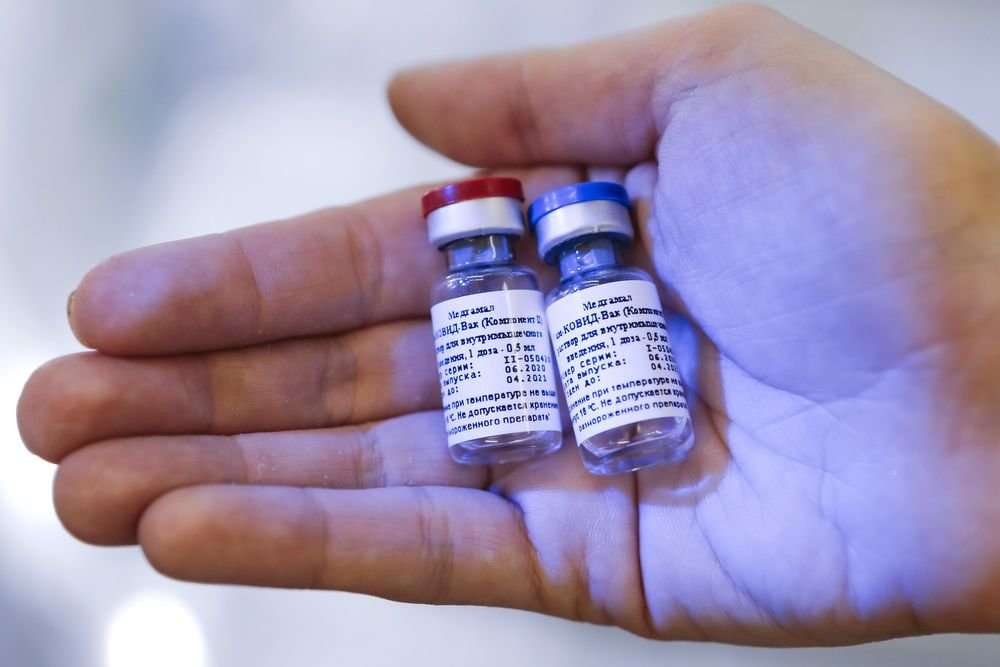
The Russian vaccine may be approved by the World Health Organization in the very near future. This will be an important step in the fight against the novel coronavirus pandemic and the green corridor, in particular for the activities of the European Medicines Agency (EMA). Where, since March, the Sputnik V vaccine has been tested for compliance with EU standards for efficacy, safety and quality.
Since the beginning of the pandemic, more than 169.4 million people have been infected with the coronavirus (as of Thursday, May 27, 2021). The increase in the incidence per day is more than 500 thousand. Over 3.5 million patients (more than 12.4 thousand people in the specified day alone) died with a confirmed diagnosis of COVID-19. More than 151 million people have recovered. Forecasts for the development of a pandemic vary radically from moderately optimistic to extreme pessimism. In the first case, the pandemic will be stopped after vaccination of more than 60% of the world’s population at the beginning of 2022; in the second, due to mutations of the virus, regular vaccinations will be required for people for an indefinite, possibly almost infinite time.
The disease that changed the world
The issues of global epidemiological safety are one of the main topics of the St. Petersburg Economic Forum, which will once again be held in the Northern capital of Russia from 2 to 5 June this year. New solutions and roadmaps are expected from SPIEF-21, many of which are unique. It is important that just a few days before the opening of the forum, the most effective vector vaccine Sputnik V received decisive recognition from the world community.
Roadmaps for the coming months will be considered at SPIEF-21, where, within the framework of the economic forum, sessions of the International Business Program Healthy Society Space will be held, covering a wide range of issues of combating infectious and noncommunicable diseases, the development of high technologies in medical care, the formation of medical ecosystems, and also the development of Russian medical science.
As Deputy Chairperson of the Federation Council Galina Karelova noted in her address to the forum participants, in 2020 Russia, unlike many countries, managed to prevent an explosive increase in morbidity and mortality, to avoid the collapse of the healthcare system. Now the medical service is returning to the planned mode of operation.
‘Special attention should be paid to increasing the availability and quality of primary health care to citizens, modernizing the infectious diseases service, and developing medical rehabilitation,’ emphasizes Galina Karelova.
New RDIF partners
On May 27, the Russian Direct Investment Fund (RDIF) and the United Nations International Children’s Emergency Fund (UNICEF) announced the signing of an agreement to supply 220 million doses of Sputnik V, a two-component Russian coronavirus vaccine, to vaccinate 110 million people. RDIF has applied for the Sputnik V vaccine to participate in the international program of the Global Alliance for Vaccines and Immunization (GAVI), where the Russian vaccine will be included in the coronavirus vaccine portfolio of the COVAX mechanism.
‘RDIF is pleased to support the international efforts of UNICEF and partners to ensure equal and wide access to coronavirus vaccines for all countries. Vaccination is the main tool for defeating the pandemic, protecting human health, restoring economies and returning to normal life,’ said Kirill Dmitriev, head of RDIF.
He recalled that Sputnik V is already in use in more than 40 countries: ‘The number is growing as we continue to ship to our partners every day. RDIF is awaiting the successful completion of the vaccine prequalification process and WHO approval, which will allow the supply of UNICEF to begin. and contribute to saving millions of lives.’
The COVAX mechanism, in partnership with UNICEF, aims to overcome the acute phase of the pandemic by the end of 2021 by providing fast and equal access to safe and effective vaccines to all countries and territories, regardless of income level. The Russian vaccine last year underwent clinical trials in Russia, Belarus, India, Venezuela and the United Arab Emirates, and under the international trademark Gam-KOVID-Vak is successful in foreign markets. According to the WSJ, more than 2.4 billion doses of Sputnik V were available and used on the global market in February of this year, in May it is already more than 3 billion doses and more than 70 importing countries. In Brazil, União Quimica has opened its own production of a Russian vaccine for export to Latin America. For the EU countries, a similar production will open in Germany this summer.
What is expected from the Russian vaccine? Not a miracle, of course. Such a miracle will be the day when the terrible diagnosis of COVID-19 will not be made to any person on Earth. What matters now is the effectiveness of the vaccines. The effectiveness of Sputnik V is higher than that of similar drugs produced by Western concerns — the reliability of the Russian vaccine against moderate or severe COVID-19 is 100%.
‘The Russian vaccine has proven to be safe and effective,’ said Russian Prime Minister Mikhail Mishustin.
‘You can definitely say absolutely officially: «Sputnik V» is one of the best in-demand vaccines in the world. Residents of Russia can now get vaccinated completely free of charge, to which I once again very seriously urge everyone.’
In terms of the number of approvals received by national government regulators, Sputnik V (71 countries, population over 3 billion) ranks second in the world. The vaccine efficiency was 97.6% based on the analysis of data from 3.8 million vaccinated Russians — this is higher than the very positive data of The Lancet experts (91.6%), according to the RDIF and the National Research Center for Epidemiology and Microbiology named after Honorary Academician N.F. Gamaleya.
Human health or…
One of the most important issues in the fight against a pandemic, this is the issue of global security, is, unfortunately, in matters of competition in different markets for vaccines developed by different manufacturers. Against the background of growing morbidity and mortality from COVID-19, the lobby and the protectionism of suppliers of certain vaccines are simply unacceptable — after all, we are talking about general security, the virus does not know the borders between states.
So, recently, the Council of Europe, and the population of the countries of the European Union and the Schengen Agreement is more than 550 million inhabitants, decided to introduce vaccination passports from July 1 of this year. There is an acute shortage of vaccines in the EU, and only 10% to 30% of the European population are vaccinated. The Russian vaccine has been going through the stage of the so-called «parallel analysis» of the European Medicines Agency (EMA) for more than two months — this is a very long time, given the shortage of vaccines. But only after certification will EMA enter the EU market. And this will not happen earlier than this summer.
Note that the European Commission does not prohibit the use of a Russian vaccine not authorized by the European regulator EMA for vaccination of the population, the governments of the EU countries can make independent decisions on vaccination of the population. It is important to make such decisions without politicization factors — the effectiveness of vaccination with one or another drug, people’s health is more important than competitive games. The pandemic situation in Europe is very uneven.
Thus, Slovakia and Hungary, members of the EU, and Serbia, which is not a member of the EU, have approved the use of the Sputnik V vaccine, and have already purchased and are using large batches of the Russian drug for vaccination. However, national programs of measures to prevent the spread of coronavirus, effectively operating at the state level, are not able to completely stop the pandemic, as recognized by the WHO.
The problem is the disproportion and even sometimes inadequacy of national vaccination programs in individual countries, the asymmetry of measures to restrict population mobility, the different rates of spread of the virus and its mutations, creating new, more dangerous strains, as well as many other risks.
An example. In neighboring Russia (where almost 11% of the population received both doses of vaccinations), Latvia does not have enough vaccines, there is a high morbidity and mortality of the population. Only 6.1% of Latvian residents are fully vaccinated today. In Estonia, over 40% of the adult population received at least one dose of the vaccine, in Lithuania at least one dose of vaccine was received by 48.9% of residents over 80 years old, 63.1% aged 70–79 years, and 45.1% in aged 60–69 years. The general epidemiological picture in Eastern Europe is spoiled by Ukraine. With an officially declared population of almost 42 million people, only 1.2%, or only about a million Ukrainians, received the first dose of the coronavirus vaccine, and less than 30 thousand people were vaccinated with both doses. Ukrainian Parliament, the Verkhovna Rada dismissed the Minister of Health of Ukraine Maksim Stepanov for the failure of the vaccination process, which does not diminish the problem.
Finally, the price component. The most expensive new type of coronavirus vaccine in the world from Moderna Corporation costs from 25 to 37 US dollars per dose, the price of a double vaccine is from 50 to 74 dollars. BioNTech and Pfizer have agreed with the US administration to sell at $ 19.50 per dose, for a total of $ 39 for two phases of vaccination. For the countries of the European Union, one dose of this vector vaccine costs 15.50 euros, two — 31 euros. The cost of a full CureVac vaccination is € 20-22, while Sputnik V costs less than $ 20 for the two required vaccinations.
Contracts and contacts in St. Petersburg
What is important, the laboratory of the mechanisms of population variability of pathogenic microorganisms of the Research Center for Epidemiology and Microbiology named after Gamaleya has clinically proved that those who received both components of the Sputnik V vaccine in case of infection with COVID-19 do not emit the virus and are not a source of danger to others. After being vaccinated with a Russian drug, in case of illness, people have a 14 times lower risk of transferring diseases in a moderate and severe form. At the same time, in this case, vaccinated people do not emit a viable virus, therefore, they are not a source of danger to others.
More detailed information on these aspects will appear during SPIEF-21 on the website www.forumhealth.ru. A significant part of contracts, including investment and development of public-private partnership projects, at this forum will be in the field of epidemiology. The international sessions of the forum’s business program within the framework of the Healthy Society Space cover a wide range of issues in the fight against infectious and non-infectious diseases, the development of high technologies in medical care, the formation of medical ecosystems, as well as the development of Russian medical science. The partners of the event are Bayer, the Novartis group of companies, Philips, Abbvie, Johnson & Johnson and other international companies. The development of innovations in the field of medicine and epidemiology in the context of a global pandemic is especially important, political and economic differences are of secondary importance today.
Присоединяйтесь к порталу «Балтия» в Telegram — https://t.me/newbaltijaeu



Ваш комментарий будет первым